How to Build a Daily AI Feedback Ritual That Actually Changes How You Sound
AI-scored daily reps build speaking skills when feedback targets one specific behavior at a time.
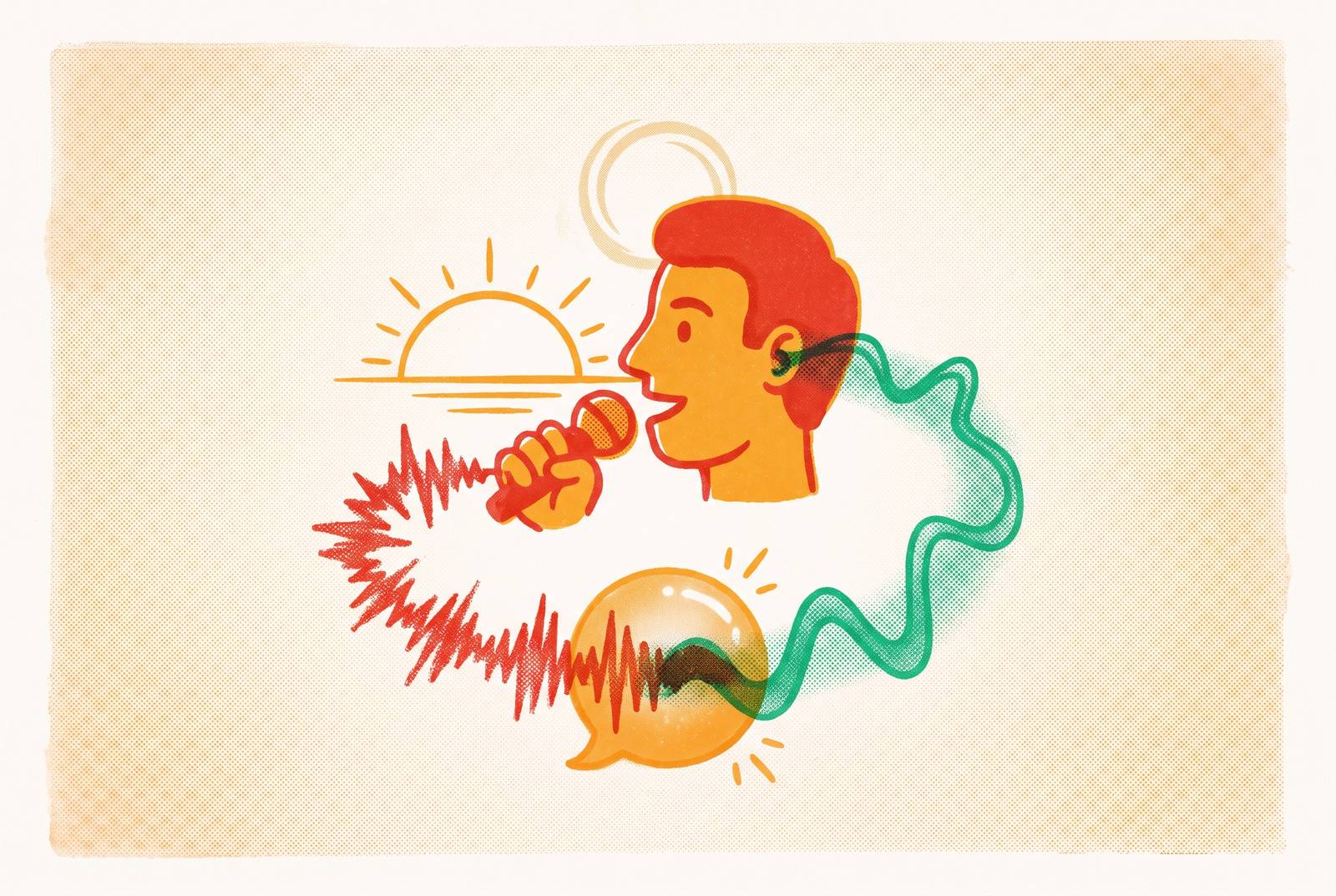
A daily speaking prompt app with AI scoring is useful when it turns a short recorded response into a specific diagnosis and a clear adjustment for the next attempt. To change how you sound, you need short reps on a regular basis and scores with feedback on what to change. A daily serving of automated encouragement falls short of the effective ritual of prompt, record, score, adjust, repeat.
Why your speaking habits are harder to change than you think
Knowing that you need to practice is different from having a practice method that changes anything. The gap is structural. Verbal fluency draws on procedural memory, the system that lets learned skills become automatic so there is no need to piece them together consciously each time. That automaticity lets you speak without having to plan every pause and transition. It also lets an unwanted pattern run without asking permission.
Casual repetition without feedback can reinforce the habits already in use, including the ones the speaker wants to lose. Someone who rushes through difficult material can give more presentations and get very good at rushing. Targeted feedback interrupts that process by identifying the behavior that needs to change before the next attempt.
Focused, deliberate practice strengthens the neural circuits used in a skill, with myelination helping make execution faster and more reliable. But efficiency is not the same as improvement. Practice has to target the right behavior for that strengthening to serve the speaker’s goal. A corrected pattern initially requires conscious effort, then gradually becomes more automatic through repetition. What comes to sound natural may therefore start with a conscious choice, such as keeping pace under control through a difficult explanation.
What deliberate practice actually requires — and why vague encouragement fails
Deliberate practice links an attempt to a specific diagnosis and then to an adjustment. Feedback that points out rushing through complex material tells the speaker what to work on in the next rep, but a broad judgment about confidence leaves them guessing about what to change.
Encouragement has a social function, but that is not diagnosis. “You did great, keep it up” names no behavior to retain, stop, or change. It can make a practice loop that failed feel as if it worked because it ends on a pleasant note. The useful distinction is therefore sharp. Feedback either connects a specific behavior to a next action, or it leaves the work of finding that connection to the person who may already be missing it.
IMD’s research with 167 global executives found that AI coaching was most useful when executives asked specific diagnostic questions. Vague prompts yielded vague returns, while specific prompts produced surprising and useful insights. Some feedback fell into a “zone of learning,” revealing blind spots the executives had not identified themselves. That is a more demanding standard than agreement.
Reflection gives those insights somewhere to go. A Fortune 500 CEO who used deliberate practice kept a journal of the specific techniques he tried, how the audience reacted, and how comfortable he felt. The record helped him see that he often rushed through complex financial data, which he then worked on in practice. The diagnosis was narrow enough to act on. Brief reflection after a speaking attempt serves the same purpose by connecting what worked and what felt uncomfortable to one concrete change, rather than allowing the session to end with a general impression.
Why short daily reps outperform occasional long sessions for changing speech patterns
For skills rooted in procedural memory, frequent short sessions provide repeated, spaced activation of the pattern being trained. A long occasional session concentrates the effort but loses that daily return to the correction. The next day’s attempt can build on the previous session rather than beginning after a week in which the intended change has received no focused rehearsal.
A 60-second response can contain a strong hook, one key idea with a supporting example, and a deliberate close. The format is compact without being empty. It creates opportunities to practice openings, transitions, and endings, so brevity does not reduce the task to merely sounding smooth. Fuller responses can run up to a couple of minutes, but length is not the achievement being trained.
Short sessions also help contain the demands on working memory. Trying to keep track of pace, filler words, structure, and tone all at once turns speaking into a small committee meeting inside the speaker’s head. Attention has limits. A daily rep aimed at one variable gives that variable a fair test, followed by a score and an adjustment tied to the same target. A general instruction to “do better” offers no comparable focus.
This is why the daily format and the feedback format belong together. Repetition without diagnosis can entrench the wrong pattern, while an excellent diagnosis without another attempt remains unused advice. The scored prompt-record loop joins them at a manageable scale. Its cumulative value comes from returning to a specific correction often enough for execution to become less effortful.
Can AI listen to your speaking and score it daily better than a coach or a mirror?
AI can provide immediate analysis of a recorded response, but it cannot reproduce a live, skeptical audience. Its usefulness also depends on task design and prompt specificity. Those limits belong at the front of the comparison. AI’s strongest role is as the infrastructure for frequent practice.
Its practical advantage is availability at the moment of practice. A human coach requires scheduling, costs money, and introduces social stakes, making daily feedback difficult for many people to sustain. AI makes those barriers easier to get past and can give feedback right after a rep, while the attempt is still fresh. A mirror leaves the speaker responsible for noticing and interpreting the very habits that may be escaping attention.
The IMD research described two ways AI can help, by preparing for a difficult conversation and by using established frameworks afterward to analyze how the person spoke. Both can be part of daily practice without a human coach having to be there each time. Specific metrics can make that analysis actionable. Filler clusters, pacing variance, and structural gaps give the speaker a target for the next rep rather than an instruction to become vaguely more impressive.
The 2026 Frontiers study found that AI conversational agents eased situational speaking anxiety for people learning a foreign language during structured pair work and presentation tasks, but had no such effect in debate or storytelling. That finding is narrower than a promise of general confidence. It supports treating structured practice as a foundation for unpredictable interaction. As basic pacing and structure become more automatic, the intended benefit is to leave more attention available for the human moments that an app cannot stage fully.
How to build the daily ritual: prompt, record, score, adjust, repeat
To put that architecture into practice, start with one specific scenario or question and a short recorded response. A 60-second answer to a direct prompt is a suitable starting format. Give the response a hook, then one idea with a supporting example, then a close. The prompt should require real-time thinking because automatic speaking habits are visible in responses that require it. “Practice speaking” is an intention.
Choose one variable to work on during that response. Pace, filler words, structure, or tone can each provide a focus, but trying to supervise all of them at once defeats the purpose of a short rep. Keep the target narrow enough to evaluate. If the recurring difficulty is rushing through complex material, evaluate whether you rushed through it rather than asking whether the whole performance sounded good.
Record the response. It is hard to judge how you sound while speaking, especially when you are busy deciding what to say next. The recording gives both you and the AI an object to evaluate. Without that recording to check together, you can easily mistake feeling uncomfortable for evidence of how you spoke.
Ask for a numerical score on a defined scale, with a diagnosis of the behavior behind it. The scale supplies a data point for tracking the chosen variable over time, while the diagnosis explains what the next attempt should change. Neither is sufficient alone. A number without a specific behavioral explanation does not tell you how to improve, and “you sounded more confident today” does not provide a stable basis for comparing sessions.
Use the diagnosis to select one concrete adjustment for the next rep. Do not turn the feedback into a lengthy repair schedule. Working on the variable that can make the biggest difference keeps the attempt deliberate and lets the next score show whether a change you tried worked. Repeat the response with that adjustment in mind, then return to the short practice loop daily. The repeated attempt is where advice becomes something you do.
Before closing the app, answer what worked, what felt uncomfortable, and what one concrete tweak should follow. Keep those observations specific, as in the CEO’s journal, rather than recording a general verdict on your ability. This reflection seals the connection between the attempt and the next session. Start with structured responses where less is at stake before trying unstructured or adversarial formats, where it is harder to know what will be asked of you and clearer where AI support falls short.
For someone choosing a daily speaking prompt app with AI scoring, the practical test follows directly from this routine. The useful criteria are a specific daily challenge, a recorded response, a defined scoring scale, a behavioral diagnosis, and a way to compare the chosen metric across attempts. A fresh prompt alone supplies variety. Likewise, a score is useful only when it helps show whether a specific change worked.
What consistent daily practice with scored feedback actually produces over time
Over time, the intended change is a shift from consciously managing a correction to executing the trained pattern automatically. That distinction has consequences under pressure. When structure, pacing, and filler reduction demand less attention, more capacity remains for reading the room, handling an unexpected response, and sharpening the argument while speaking.
An executive presence case illustrates what that shift can look like to an audience. After two months of focused deliberate practice, board members remarked on an executive’s significantly stronger presence, with one saying “when she speaks now, everyone stops and listens”. The outcome was perceptible beyond the practice session. The case illustrates deliberate practice rather than establishing a guaranteed timetable or an AI-specific result, but it gives the destination a concrete form.
Human speaking skills matter more as AI takes on more of the work of writing and analysis. A person’s contribution then depends increasingly on what they can do live, in a room or on a call, where responses cannot all be prepared in advance. Using AI to train for those moments is not a contradiction. The tool helps the speaker practice the basics so they take less attention when human judgment is needed.
The strongest objection remains that a speaker might become fluent with an algorithm and still freeze with a person. That possibility remains a design constraint even with a rising score. Daily structured reps build a foundation, and speaking with people tests whether it holds when they ask something unfamiliar of the speaker.