Assertiveness Training Programs for Young Professionals
Talking isn't enough—here's how to speak with actual authority at work.
Young professionals talk constantly: in messaging threads, in group chats, in meetings that could have been emails and emails that should have been meetings. Young professionals have not gone quiet. Talking and assertive communication are different skills, and fluency in one does not guarantee competence in the other. One researcher who studies workplace communication frames the mismatch precisely this way: high verbal output does not equal the specific behavioral toolkit that makes a statement land with authority in a live, high-stakes exchange. Gen Z in particular came of age professionally during a stretch when remote work and digital-first interaction were the default setting, so meetings, negotiations, and feedback conversations, the exchanges where assertiveness actually gets tested, got far less live practice than prior generations logged at the same career stage. That is a gap in repetitions, and repetitions are exactly the kind of thing a person can make up for later.
What Assertiveness Is and Is Not
Assertiveness sits between two failure modes, and most people spend their careers oscillating between them without realizing a third option exists. Passive, aggressive, and assertive are situational habits: someone can be passive with a supervisor on Monday and aggressive with a peer on Tuesday, depending on context and on which behaviors they have actually practiced. Assertive communication expresses thoughts, needs, and boundaries directly and with respect for the other party, which structurally separates it from aggression (disregards others' rights) and passivity (suppresses one's own). For a young professional who worries that speaking up reads as arrogance, this distinction matters: training offers a third lane that is neither doormat nor bulldozer.
The specific toolkit underneath assertiveness can be named. "I" statements, such as "I feel frustrated when my input isn't considered," invite understanding instead of triggering defensiveness, and they work because they are a sentence structure anyone can learn, not a trait some people were born with. Body language, posture, eye contact, vocal steadiness, carries equal weight: assertive words paired with a defensive slouch undercut the message even when the content is correct. The broken record technique, calmly repeating a firm position until it registers, shows resolve without escalating, which makes it useful in a salary negotiation or in declining a request that should never have been made. Role-play ties these pieces together by giving high-stakes scenarios a low-stakes rehearsal space, and that rehearsal is what turns an assertive response from an effortful decision into an automatic one.
The science behind why these behaviors can be trained rather than inherited
Assertiveness changes through the same mechanisms that govern any skill acquisition: repetition reshapes habits, and reshaped habits reshape self-perception. Cognitive-behavioral training programs raise self-esteem and increase a person's sense of control in social situations, and the mechanism runs deeper than rehearsal alone. Once someone has evidence that they speak up and survive it, they start believing they are the kind of person who speaks up, and the belief reinforces the behavior that produced it.
Fluency, the ability to express a thought smoothly without hesitation, is trainable rather than innate, and eloquence (fluency plus persuasion and precision) improves the same way: through structured practice. One technique carries outsized value for almost no cost: reframing pre-performance anxiety as excitement. The physiological state, elevated heart rate, adrenaline, is identical in both cases. Only the label changes, and the label changes the output. Telling yourself "I am excited" before a difficult conversation produces measurably better performance than telling yourself "I am calm," because calm asks the body to do something it is not currently doing, while excitement just renames what it is already doing.
Short daily practice compounds this. Speaking on a random topic for a short, uninterrupted burst builds the verbal agility that formal preparation never touches, the agility needed for an unexpected question in a meeting or a pushback that arrives in real time with no script available. A couple of weeks of this drill produces a noticeable shift in how smoothly a person speaks under pressure.
The standard objection deserves a direct answer: some people are naturally more confident, so why train the rest. Confidence and eloquence are the output of repeated assertive behavior, not a precondition for attempting it. Training programs do not wait around for confidence to show up on its own. They build it through the repetitions themselves, which is a more useful fact than it sounds, because it means confidence is available on a timeline instead of locked behind a personality trait.
What the career research shows assertiveness training produces
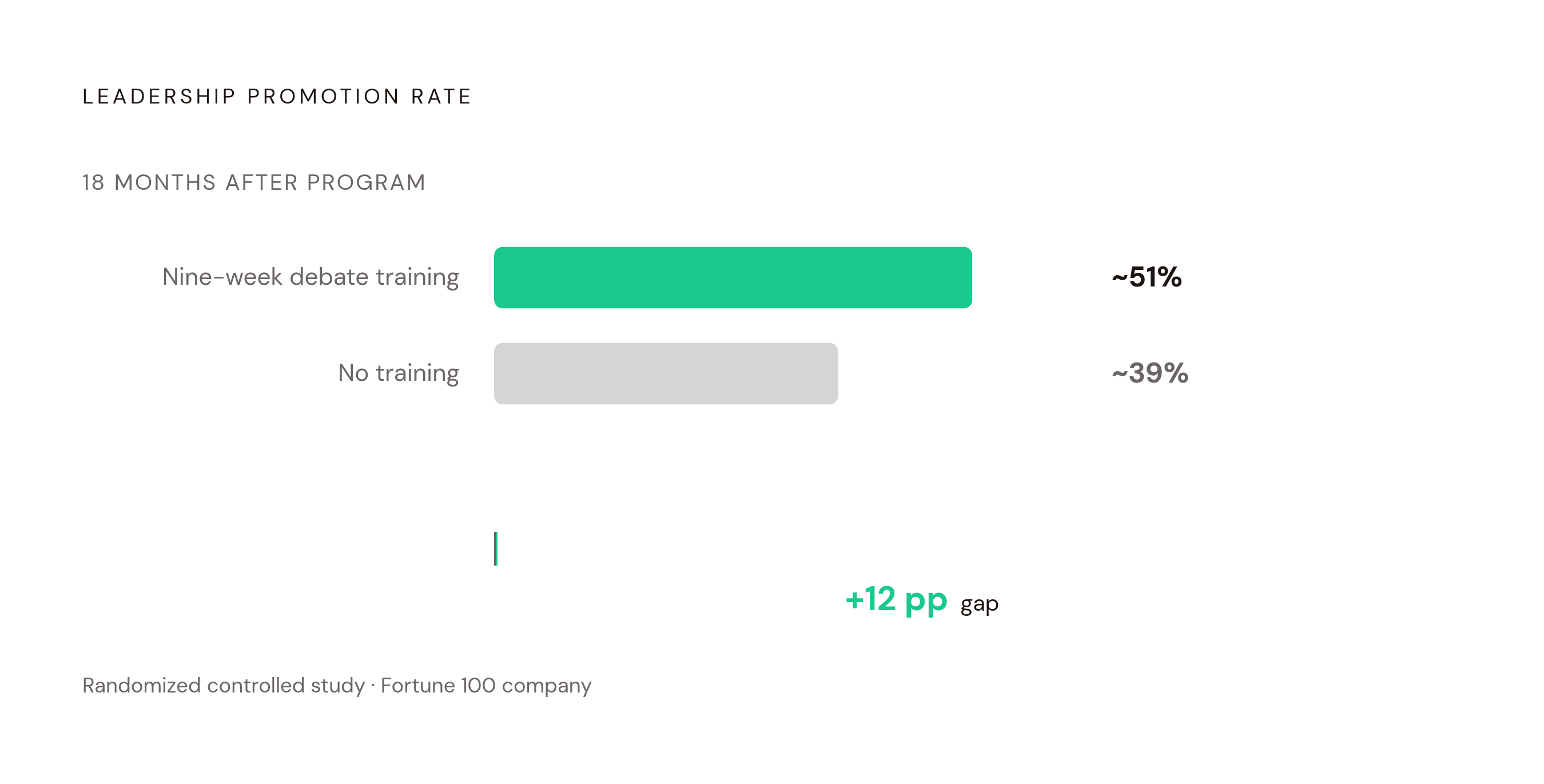
The career case for this kind of training rests on a randomized field experiment, which is rare enough in this field to matter on its own. MIT Sloan's Jackson Lu and colleagues ran the study, published in the Journal of Applied Psychology, at a Fortune 100 company: a large group of employees was randomly assigned either to a nine-week debate training program or to no training. Well over a year later, the employees who completed the program were roughly twelve percentage points more likely to have moved into leadership roles than the ones who did not. The study, called "Breaking Ceilings," won the 2025 Best Paper in Management Education and Development Award from the Academy of Management's Management Education and Development Division. The effect held across genders, ethnicities, and backgrounds, which makes structured assertiveness practice a tool that can level a playing field rather than one that only accelerates people already positioned to advance.
The inverse holds too. Fear of public speaking and low verbal confidence track with lower earnings potential and a reduced shot at management, so training that builds assertive habits addresses both ends of the problem: the ceiling that blocks advancement and the floor that limits pay.
Lu himself raises the sharpest objection to his own findings: the study measures leadership emergence, meaning who gets selected for leadership, not leadership effectiveness, meaning who performs well once they get there. An organization running on this evidence alone risks promoting its most assertive voices while undervaluing its most collaborative ones. That is a real limit on what the data can claim, and the honest reading is that assertiveness training is one tool in a larger kit, not a replacement for competence. It gets a person heard and selected. Earning the role afterward is still a separate job.
The programs available now, and what distinguishes them from each other
Programs in this space mostly agree on the underlying theory. Where they differ is format: whether training happens live or asynchronously, how closely it simulates a real verbal confrontation, and whether any feedback loop closes after the practice ends.
The MIT-affiliated debate program run inside a Fortune 100 company stands alone in one respect: it is the only option backed by large-scale randomized evidence tying the training to an actual leadership outcome. Nine weeks, structured debate format, a measurable twelve-point lift in leadership emergence 18 months out. It was an employer-run intervention rather than a program open to public enrollment, making it a benchmark for what rigorous assertiveness training can achieve.
South Western Railway took a different route for its Gen Z apprentices, partnering with an improvisational theatre company to run workshops aimed at building confidence and communication. The format is unstructured and scenario-based, built around live spontaneous response rather than scripted drills, which makes it a close match for the exact gap digital-first communication habits created in the first place: the muscle for thinking on your feet in a live exchange.
Live, two-day intensive courses also exist in this market, running in formats that combine in-person and online instruction, often with a workbook, a retake option, and a certificate attached at the end, priced in the four figures for the full live version. Whatever the format, three questions sort the useful options from the decorative ones. Does the program include live role-play or scenario practice, not just video instruction a person watches passively. Is there a feedback mechanism, whether scoring, instructor response, or video review, that closes the loop on what was practiced. Encouragement alone does not build a skill. Feedback does, because it is the only part of the loop that tells a person whether the repetition they just did actually improved anything.
Building Assertiveness as a Daily Habit
A workshop builds awareness of the technique. Daily practice is what turns that awareness into instinct, and the second part does not require enrollment in anything. Assertiveness follows the same acquisition curve as any physical skill: the first repetitions feel awkward and self-conscious, and only volume closes the distance between knowing how to do something and doing it without thinking about it.
A few drills do most of the work. The 30-Second Sprint, speaking on a random topic without stopping for a short burst, builds verbal agility and cuts down the hesitation that makes a young professional sound less confident than their actual grasp of the material would suggest. Before a difficult conversation, writing or saying the "I" statement version of what needs to be said works less as a script and more as a rehearsal that makes the assertive framing available in the moment it is needed. And the anxiety-to-excitement reframe applies here too: before a high-stakes meeting, relabeling the nervous energy as excitement keeps that energy working for the conversation.
None of this works without feedback. Practice without it just reinforces whatever habits a person already has, good or bad. Scoring, a structured instructor response, a video review, something has to make the improvement visible, because visible improvement is what keeps a person doing the drill on day twelve.
The timeline rewards patience, but not much of it. Participants in the MIT debate program showed measurable effects 18 months after a nine-week intervention. Daily verbal practice over a couple of weeks produces a noticeable change in fluency under pressure. Assertiveness is a set of behaviors built through repetition, not a personality a person either has or lacks, and the gap between being heard in a meeting and being passed over for the next promotion runs straight through whether those repetitions happened.
Sources
- Assertiveness Skills Course Online & Washington, D.C.
- What Assertive Communication Means for Gen Z and Why Do They Need the Skills?
- Assertiveness, Non-Assertiveness, and Assertive Techniques Introduction
- Effects of Three Assertion Training Sessions on Schoolchildren’s Assertiveness and Mental Health
- Assertiveness Training - English Fact Sheets - ABCT - Association for Behavioral and Cognitive Therapies
- The Role of Assertiveness on Career Adaptability and ...