How Serious Speakers Use Weekly AI Score Reports to Prove They Are Getting Better
Weekly trendlines reveal which speaking skills are actually improving across sessions.
AI speech scoring and feedback for everyday practice are useful when they show which speaking skills improve across repeated sessions. Speech Skills AI and Wellspoken score several dimensions of delivery, giving speakers more to work with than generic encouragement. The strongest evidence of progress is a weekly trendline that separates gains, plateaus, and regressions, then gives the next practice session a clear purpose.
Why a single AI score tells you almost nothing about whether you are improving
A speaker checks the score after a recording, feels briefly pleased or disappointed, and closes the app. The number looks like a verdict. Without earlier scores on the same scale, it describes a performance with improvement left undetermined.
That difference is easy to miss because a score feels more certain than spoken feedback. Yet energy, topic familiarity, and ambient noise can move the result several points without any underlying skill change. A strong session might come from knowing the subject well, while a weak one might come from being tired. Neither result becomes evidence of growth simply because it has a decimal point. The missing ingredient is comparison across enough sessions to distinguish a developing skill from a good afternoon.
What AI coaching tools are actually measuring, and why those dimensions compound over time
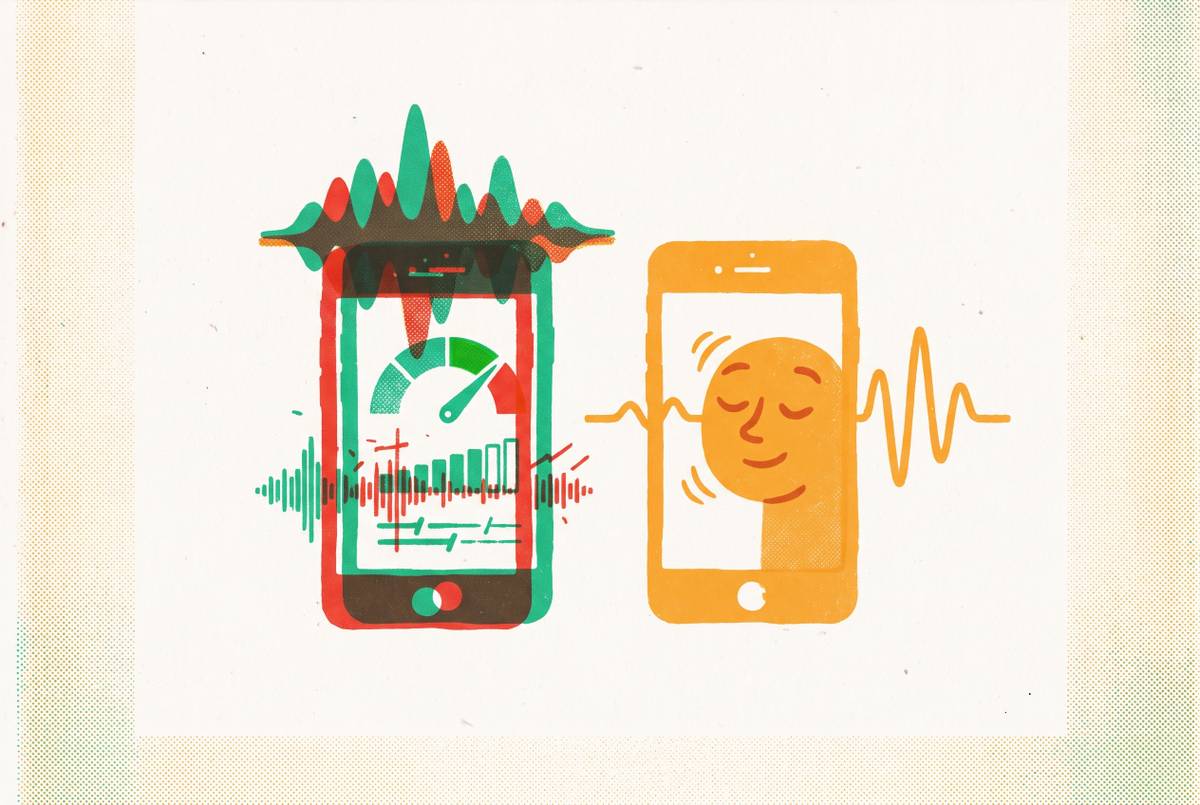
What app gives a real score on presentation delivery? The useful distinction is whether it measures specific behaviors and explains its scoring dimensions. Automatic speech recognition works with acoustic feature extraction to turn a recording into a timestamped transcript and measure features of delivery. These include filler rate, pace, pause length, and pitch variance. Judgments based on these measurements vary in dependability.
Filler rate counts occurrences of “um,” “uh,” and “like” per minute, while pace measures words per minute. The usual target for presentations is 140–160 WPM, and speakers who do this well pause for roughly 0.5–2 seconds at sentence boundaries. Pitch variance helps distinguish expressive delivery from monotony, which correlates with listener disengagement. These are behaviors a speaker can change through practice. They are more useful targets than an instruction to sound impressive.
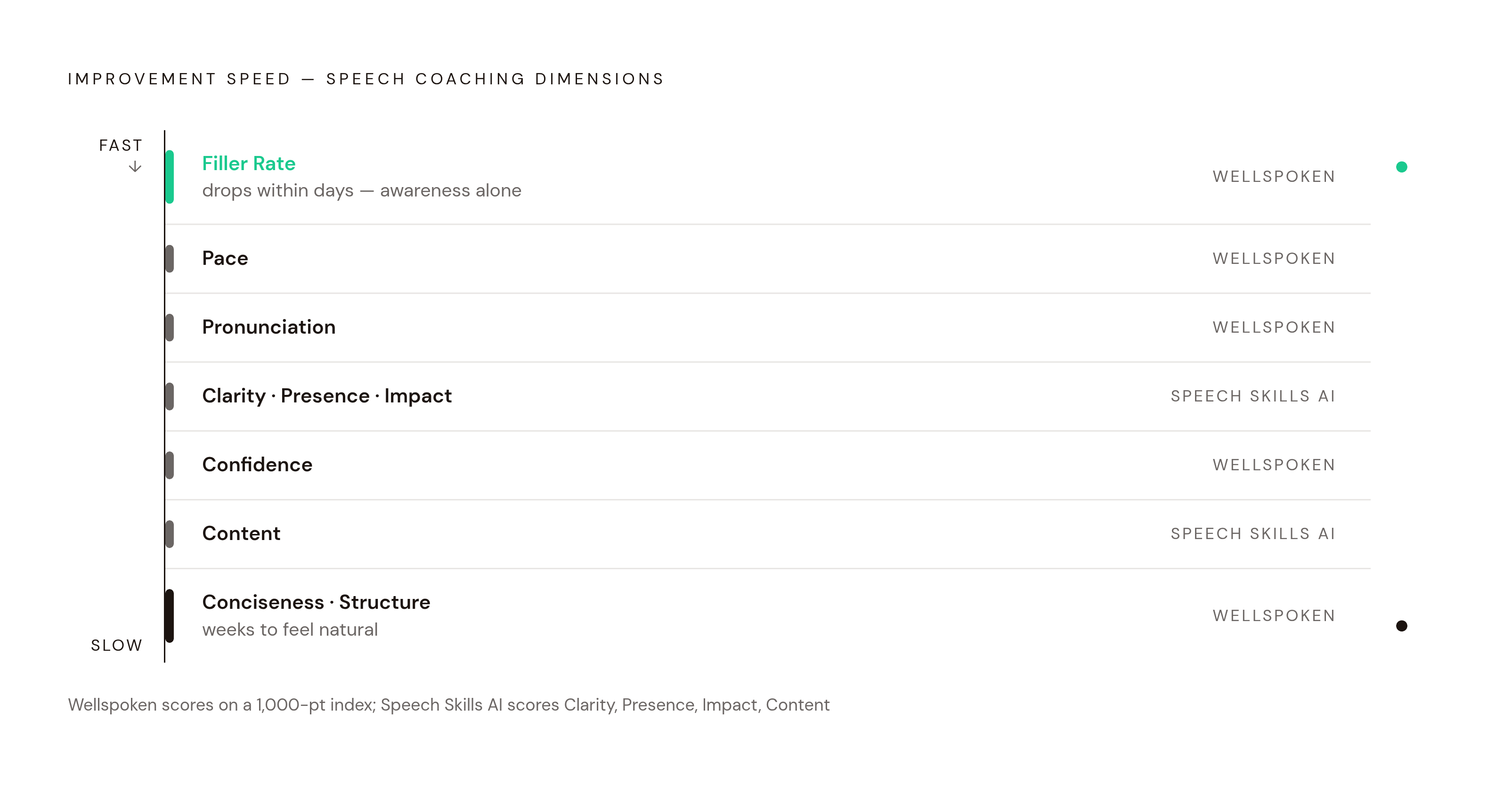
Speech Skills AI organizes its feedback into Clarity, Presence, Impact, and Content, covering structure, delivery cues, persuasiveness, and message quality. Wellspoken measures structure, conciseness, confidence, pronunciation, filler rate, and pace on a 1000-point index. These rubrics make judgments as well as count things, so their scores need to be read with care. They also show that skills improve at different speeds, because noticing fillers can help a speaker cut them quickly, while structural clarity and conciseness take several weeks longer to feel natural. Over repeated sessions, these separate gains can build on one another and stay visible.
How the weekly trendline converts raw scores into actionable intelligence
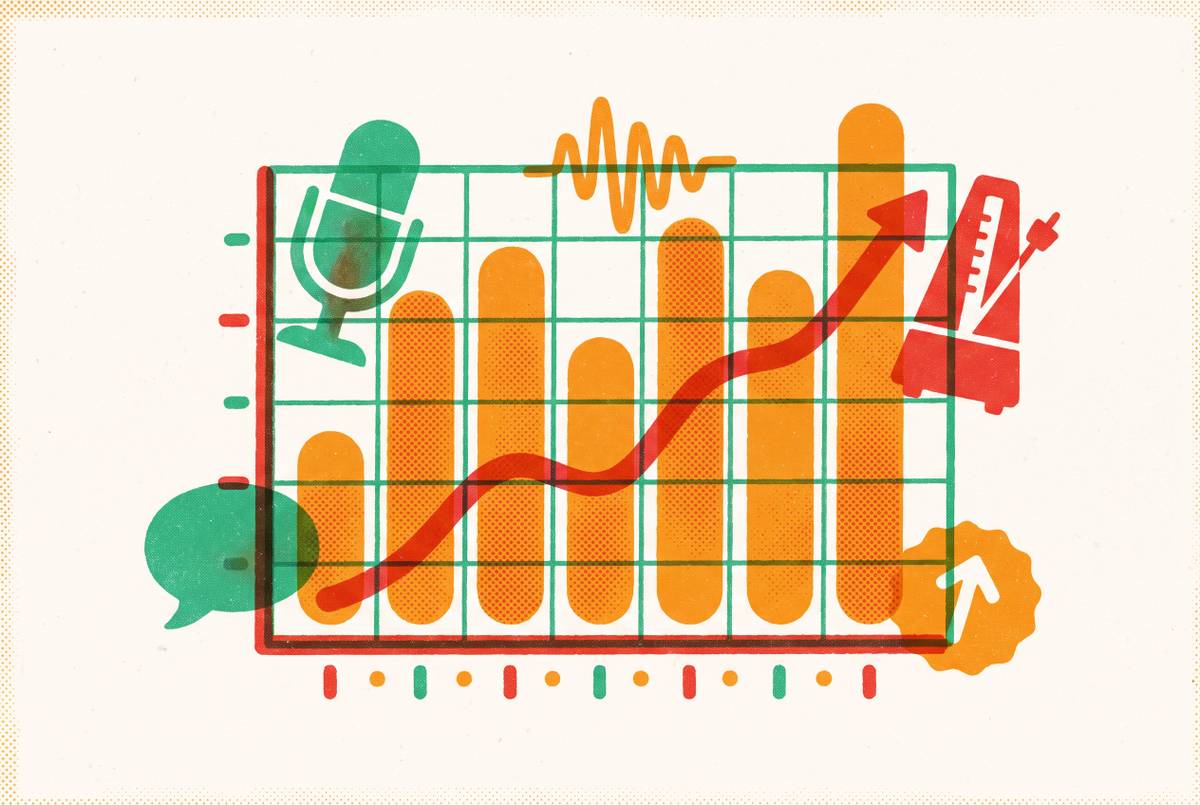
A weekly average compresses several performances into a number, but the useful report preserves the direction of each dimension. Pace may be getting better while structure stays the same. Filler rate may rise even as the overall score stays the same because another dimension has improved enough to make up for it. The aggregate conceals the trade-off. Dimension-level tracking exposes it and makes the next practice target less speculative.
Imagine a speaker whose overall score rises while filler rate stays at the same level for three weeks. “The score went up” would suggest that the current routine is working across the board. The filler trend says something narrower and more useful, namely that one behavior has stopped responding to the routine. Likewise, a pace plateau after three weeks of improvement suggests that awareness-driven gains may be exhausted and a different drill is needed.
The same report can show that filler rate fell over ten sessions while the average sentence grew shorter. Over weeks and months, the record makes gains and persistent weaknesses visible enough to act on. The practical response is to choose one change for the next recording and check whether it holds. In this sense, the report is not the prize at the end of practice but the steering mechanism for what comes next.
The deliberate-practice engine underneath the score-and-repeat loop
That steering mechanism is what connects weekly tracking to deliberate practice. Structured repetition with immediate, specific feedback gives a speaker a behavior to adjust and an opportunity to test the adjustment. Vague praise cannot do that work. “That was better” provides encouragement, but it does not identify what should survive into the next attempt.
Short, repeated sessions also keep the feedback close to the behavior that produced it. The speaker can review a particular weakness, try a change, and hear the result before the original attempt becomes a hazy memory. Repetition then helps the change become more automatic. The weekly view serves a different purpose, showing whether that correction persists beyond the recording in which it first appeared.
Reframing pre-performance anxiety as excitement, instead of trying to suppress it, can support greater verbal fluency and higher observer ratings of confidence. Practice, recording, and reflection can likewise build self-confidence while reducing anxiety. Going through this again and again can help that reframe feel familiar. The score is therefore part of a practice system.
Where weekly tracking delivers its biggest returns in careers, pitches, and high-stakes conversations
Hu and Ma’s 2025 paper found that positive pitches made funding more likely, looking at delivery dimensions separately from content and keeping business fundamentals the same. Vocal positivity was part of that effect. Tracked practice offers a way to work on delivery before the conversation in which funding is at stake. It does not turn a speaking score into a forecast of investment.
In job interviews, too, delivery needs to fit the purpose. Speech Skills AI’s Job Match Score brings together how well someone delivers their speech and the context they upload, including a CV, LinkedIn profile, and job description. Sales coaching applies a related principle at scale, connecting repeated feedback to consequential conversations. The individual practice habit mirrors that structure without guaranteeing a particular commercial outcome.
Leadership adds a harder test, because being clear is not the same as being remembered. A compelling narrative can distinguish a speaker from someone who simply delivers bullet points. Weekly practice can help speakers move from bullet points to a story by working on structure and delivery, but storytelling takes more than getting the mechanics right. Narrative arc, tension, and sensory detail resist reduction to pace and filler counts. The trendline can show that delivery is becoming ready to support a story.
The legitimate objection is what weekly scores cannot measure, and how serious speakers account for that
A mechanical improvement is not proof of persuasive impact. AI can track pace, filler rate, and pause distribution without knowing whether an audience connected with the speaker or accepted the argument. That boundary is easy to blur when a product labels a score “confidence” or “impact.” Sentiment and tone analysis from audio still cannot be relied on. A confidence score of 72/100 reflects a model’s assumptions about what confidence sounds like.
Speech recognition also performs less reliably on accented speech, regional dialects, and noisy audio. Scores can therefore be systematically skewed for people whose speech differs from the training data’s center of gravity. Directional tracking is more useful than treating those scores as absolute verdicts, but it does not erase those limitations. Comparability still needs scrutiny. A changing recording environment can complicate the interpretation of a changing number.
Even accurate counts become poor targets when optimized blindly. “Um” and “uh” serve cognitive functions for listeners, so reducing fillers to a manageable level is different from pursuing zero at all costs. The latter can produce robotic, over-rehearsed speech. A talk-to-listen ratio can be equally misleading when an audience genuinely wants one person to keep talking. The resolution is to use AI tracking between human coaching sessions, with real-world speaking opportunities testing what the dashboard cannot see.
Building a weekly tracking habit that actually produces the trendline
To turn that broader system into a routine, start with five to ten focused minutes of daily short-form practice. Record a response to a specific prompt, review the dimension-level feedback, and identify one behavior to target. Then re-record and check whether the change held. Keep the task small enough to repeat. The point of the short format is a tight feedback loop and a steady supply of comparable attempts.
Choose one dimension for each two-to-four-week block, beginning with filler rate, then pace, then structural clarity. If several targets change at once, a regression becomes harder to attribute to any particular adjustment. The weekly review should help decide whether to continue the current focus or change the drill.
Set the communicative goal before recording so that comparable scores reflect comparable work. Speech Skills AI’s Intention Wizard uses Purpose, Audience, Tone, and Outcome to set up each session. Its broader rubric and Job Match Score suit practice tied to a given message or opportunity, while Wellspoken’s six-dimension index gives speakers a clear way to look at structure and delivery together. The choice depends on the work being practised. Neither a larger index nor a more elaborate label establishes that one tool gives more honest feedback.
For teams, Speech Skills AI’s Progress Views let L&D leads and managers see who is practising and improving without reviewing recordings. That makes the same habit a group accountability tool. Poised’s closure is also a reminder that the coaching market changes. The report is only as useful as the focused, repeated practice that supplies its evidence.
Why Gen Z and young professionals are the most motivated — and the most underserved — weekly trackers
For early-career speakers, that evidence addresses a gap between ambition and opportunity to practise live. Comfort with dashboards and visible progress does not automatically provide experience of interviews, pitches, or leadership conversations. Reduced in-person interaction during formative years and a shift toward asynchronous digital communication help explain the perceived communication gap. Structured speaking work offers a way to close it without turning generational shorthand into a verdict.
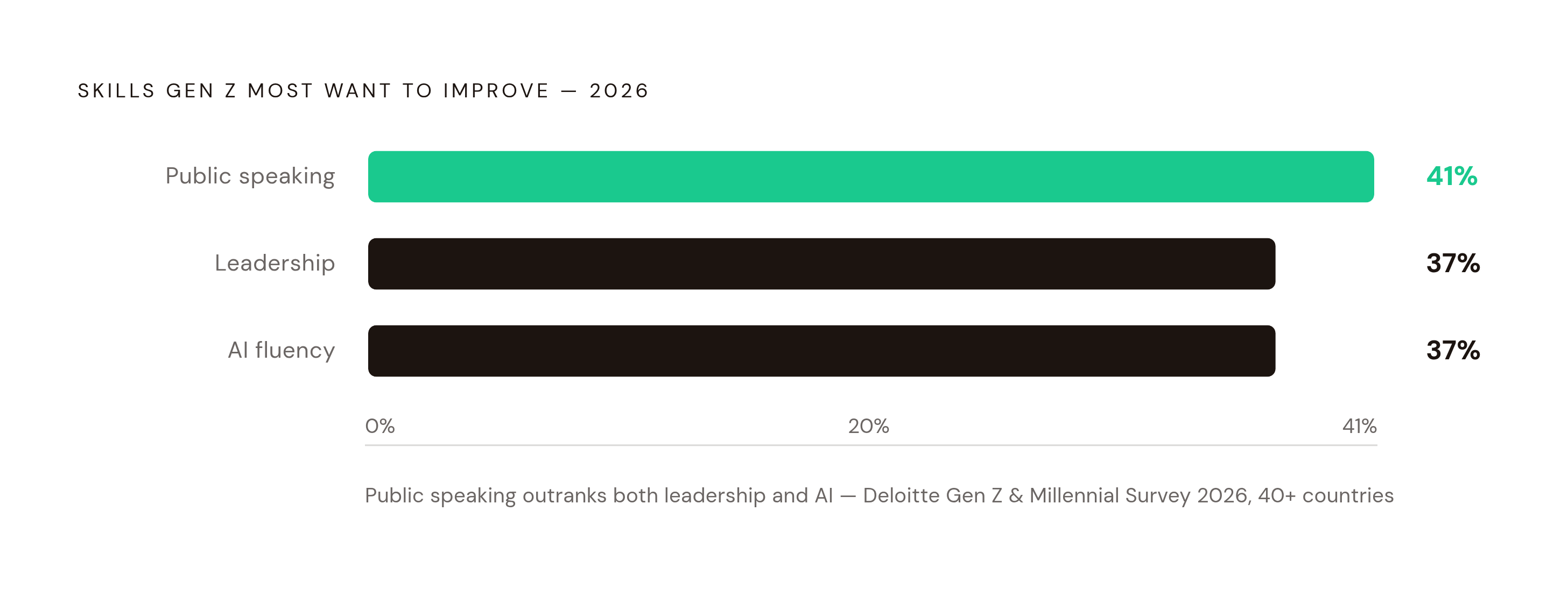
Deloitte’s 2026 Gen Z and Millennial Survey, covering tens of thousands of respondents across more than forty countries, identifies public speaking as Gen Z’s top skill to develop at 41%. Leadership and AI fluency both stand at 37%. The demand is explicit. For young workers already using AI to improve their skills, scored speaking practice extends an existing habit into an area with direct career consequences. Short sessions, visible feedback, and incremental gains fit that aim without requiring confidence in advance.
The competitive advantage is a documented record of sustained work on the dimensions that help someone be understood and remembered. That record gives personal development a firmer basis than self-reported confidence or one unusually good session. The trendline is the proof of measurable progress. Serious speakers are building a history of dimensions climbing over time, and that work is available to anyone willing to practise daily.