Spoonerisms and What They Reveal About Speech Production
Brain errors reveal how speech gets assembled before you speak.
Spoonerisms are named after Rev. William Archibald Spooner (1844 to 1930), an Anglican clergyman and scholar who spent decades at New College, Oxford, eventually rising to Warden. Legend credits him with lines like "you have hissed all my mystery lectures," supposedly aimed at a student who had missed a history lecture and wasted the whole term, or telling that same student to leave Oxford on the next town drain.
Spooner almost certainly never said most of these. What's documented, rather than embellished, is that Spooner was an albino with a visual impairment, and the agitation of struggling to read his own notes in front of a room may have genuinely made his speech worse. So there's a real physiological thread under the folklore, even if the specific quotes are fan fiction.
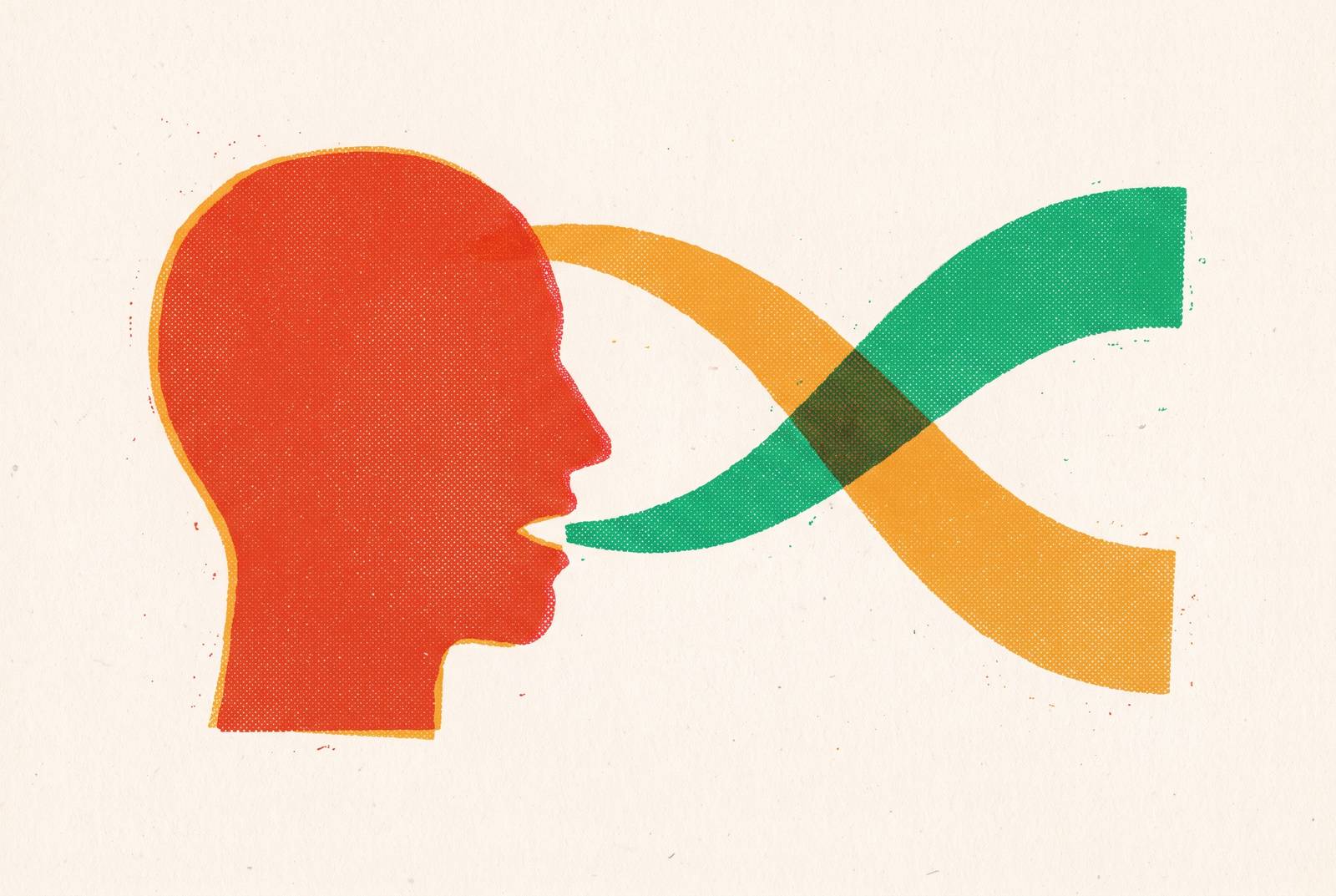
The gap between legend and fact is itself informative. The jokes stuck around and multiplied because the underlying error follows a consistent shape: sound swaps happen at predictable points, between comparable units, producing a specific flavor of nonsense rather than pure gibberish. That consistency is the tell. A truly random speech glitch wouldn't be funny in the same repeatable way twice. One classic example is "The Lord is a shoving leopard," an unintended rearrangement of "a loving shepherd". Another instance is "Mardon me, Padam, you are occupewing my pie". A further example is "Three cheers for our queer old dean!," intended as a toast to Queen Victoria.
Spoonerisms versus unintentional psychological slips and other speech errors
Freud's original claim was that speech errors reveal a hidden wish or a repressed thought pushing into conscious expression. Modern psycholinguistics takes a much less dramatic view: most tongue slips don't need a therapist's chair, they need a flowchart. The brain runs an enormously complex, high-speed assembly line to produce speech, and most errors are just that line jamming.
There's a nuance, though. What's active in someone's mind at a given moment can shape which errors surface: a stressed speaker produces more anxiety-flavored slips, someone thinking hard about a deadline might blend that word into an unrelated sentence. That's not repression leaking out, that's cognitive load elbowing its way into a system already juggling several jobs at once. Spoonerisms sit inside a much bigger taxonomy of speech errors that includes substitutions, blends, repetitions, and the classic failure to retrieve someone's name at the worst possible moment, and each type points to a different stage of the production pipeline breaking down. A spoonerism says something about phonological planning, not about what a speaker secretly wants. That distinction matters for how seriously anyone should take the slip.
The multi-stage machinery the brain runs before a word leaves your mouth
Speech feels instant. Speech feels instant, but it is not. Before a single word gets spoken, the brain has already picked the intended meaning, pulled the right words in the right order, retrieved the sounds that make up those words and slotted the phonemes into position, and lined up dozens of muscles in the jaw, tongue, lips, and larynx to fire in sequence. All of that happens fast enough, and automatically enough, that speakers never notice it's occurring, and that invisibility is exactly why errors matter: they're the only window into a process that otherwise hides itself completely.
Research on motor control describes distinct levels of representation stacked inside this planning process. There's a word level, which respects syntactic category (nouns swap with nouns, verbs with verbs), and a phoneme level, which respects the line between consonants and vowels. Errors almost never cross those lines carelessly. Consonants trade with consonants, vowels trade with vowels, nouns trade with nouns, and that "birds of a feather" pattern isn't a coincidence, it's evidence. If the architecture didn't exist, errors would be a free-for-all. Instead they respect boundaries that speakers have no conscious awareness of, which is precisely how researchers infer that the boundaries exist. That architecture is what the next stage of this piece leans on, because spoonerisms are the specific error type that exposes the phonological planning layer best.
Spoonerisms and the brain's speech-planning horizon
The single biggest thing a spoonerism proves is that the brain is holding several words active at once before any of it gets spoken, rather than drafting speech one word at a time, like someone typing a sentence letter by letter. It's holding several words, sometimes a whole phrase, active simultaneously before any of it gets spoken. A swap like "well-boiled icicle" for "well-oiled bicycle" pulls sound material from across an entire planned phrase. That kind of cross-word contamination is only possible if the whole phrase was sitting in a buffer, loaded and waiting, before articulation ever began.
MacKay's 1970 analysis in Neuropsychologia looked at 124 naturally occurring spoonerisms from German speakers and found that the phonemes involved in a swap usually matched on articulatory features (voicing, nasality, how open the mouth was, where the sound sat in the syllable) but differed in place of articulation more often than pure chance would predict. In other words, the errors aren't noise. They follow the grain of the system, honoring its internal rules even as they break its intended output, and that's exactly the kind of pattern that tells researchers a rule-based system exists. This isn't an English quirk, either. Children produce spoonerisms, and speakers across essentially every language studied produce them, which points to something built into how the human brain organizes speech generally, not something specific to English phonology.
Consonant and vowel swap rates in neural data
One detail stands out once someone starts paying attention to real spoonerisms: consonants swap with consonants, vowels swap with vowels, and a consonant almost never trades places with a vowel. It's a pattern that emerges naturally from how the brain organizes speech, with no speaker ever taught the rule. It's a byproduct of how the brain actually files these sounds.
A 2013 study led by Kristofer Bouchard, using recordings from three epilepsy patients with electrodes implanted directly in the brain, found that the neuronal firing patterns for consonants are distinct from the patterns for vowels. More specifically, the brain seems to sort phonemes by the physical mouth movement needed to produce them rather than by how they sound to a listener. Consonants cluster into groups: front-of-tongue sounds like s, th, and l; back-of-tongue sounds like g and k; and lip sounds like m, p, and b. Vowels split into rounded-lip sounds like oo and u versus unrounded ones like aa, ee, and i. Edward Chang, a co-author on that study, told Nature that this overlap is exactly why tongue twisters are hard, because sounds that share neural territory (s and sh, both front-of-tongue) are primed to interfere with each other. It also explains why a phrase like "she sells seashells" trips people up: s and sh aren't just acoustically similar, they're neural neighbors competing for the same real estate. So when a tongue trips, that's two overlapping brain representations colliding in real time, a genuine physical event rather than a character flaw or a sign of nerves.
Stress, fatigue, speed, and divided attention as causes of planning system failure
Under normal conditions, spoonerisms are rare. Corpus studies of naturally occurring speech errors show they happen far less often than substitutions, omissions, or repetitions, and controlled lab experiments put their rate below 1% of all recorded slips. That rarity is the actual finding here. The planning system mostly works, and works well, so the exceptions are cracks in an otherwise solid wall.
Certain conditions widen those cracks. Speaking fast compresses the planning window, giving the brain less runway to check its own output before it fires. Fatigue dulls the internal monitor that would normally catch an error before it becomes audible. Multitasking pulls attentional resources away from phonological planning and toward whatever else is competing for bandwidth. Stress raises error rates too, since a mind preoccupied with anxiety tends to let that preoccupation leak into word selection. Bilingual and multilingual speakers juggling more than one sound system at once face a higher chance of cross-system interference, especially in whichever language is less dominant for them. None of this means frequent spoonerisms signal a disorder. Isolated slips are harmless. A consistent pattern suggests phonological awareness looks like a broader struggle elsewhere.
The word "butterfly" has been claimed, per the motor control literature, to be a fossilized spoonerism of "flutter-by". Etymologists reject the story, since Old English already had "buterfleoge" long before any "flutter-by" shows up on record, but if the claim were true, it would mean a spoonerism quietly worked its way into the dictionary through the same kind of historical sound-swap process linguists call metathesis.
Spoonerisms, tongue twisters, and trainable speech mechanics
Tongue twisters are basically spoonerisms with the safety off. Someone designed them, deliberately, by stacking sounds that share heavy neural overlap, pushing the planning system toward exactly the failure point spoonerisms expose naturally. The relationship runs in both directions. Understanding why spoonerisms happen explains why certain twisters are brutal to say quickly, and practicing those twisters trains the very system that spoonerisms reveal to be imperfect under load.
Actors, politicians, and professional speakers use tongue twisters for this reason, and it isn't a kids'-table exercise. The practice sharpens phonological precision by tightening the gap between sounds that live close together in the brain's neural map. It builds articulation speed under load by deliberately compressing the planning window rather than waiting for stress to do it involuntarily. And it supports accent work through alliteration, isolating one sound target and drilling it in repetition until the muscle sequence gets automatic. There's a further move available: deliberately constructing near-spoonerisms and then correctly navigating them builds a kind of self-awareness of one's own phonological wiring, treating the error not as something to avoid but as a target to train against. The mechanism that produces the slip in the first place (holding multiple words active in a planning buffer) is the exact mechanism that gets stronger through deliberate, repeated practice at speed.
Spoonerisms and the stakes of high-speed verbal performance under pressure
The conditions that stress the phonological planning system hardest, namely speed, anxiety, and cognitive load, are the same conditions that define high-stakes verbal performance. That's not a coincidence worth glossing over. Somewhere between 72% and 75% of adults report a fear of public speaking, and roughly 80% of employers prioritize verbal communication skills when hiring, according to a National Association of Colleges and Employers study. Anxiety raises the rate of speech errors, which means the planning system degrades exactly when the room is watching most closely. The fear and the failure feed each other.
South Western Railway ran into a version of this directly. Its apprentices, largely Gen Z, were defaulting to texts and messages over live conversation, and Keeley Quinn, the company's Apprenticeship Compliance Manager, flagged gaps in verbal clarity, assertiveness, and the confidence to make a decision out loud in real time. SWR's response was to bring in The Free Association, a London-based improv theatre company, for custom workshops built around exactly this problem. Improv works as an intervention because it forces real-time verbal planning under social pressure, the same conditions that expose a shaky phonological system, and the same conditions in which improvement is actually measurable rather than theoretical. Storytelling, live conversation, and formal speaking are all high-load planning tasks, and none of them are innate skills that show up fully formed. They degrade under pressure without practice and sharpen with it. Spoonerisms make the underlying claim concrete: fluent speech is a trained mechanical skill running under extraordinary cognitive constraints, its failures are predictable, its improvements are measurable, and the distance between merely talking and actually commanding a room is a mechanical gap that practice closes.
Gen Z's confidence in verbal fluency and awareness of the gap
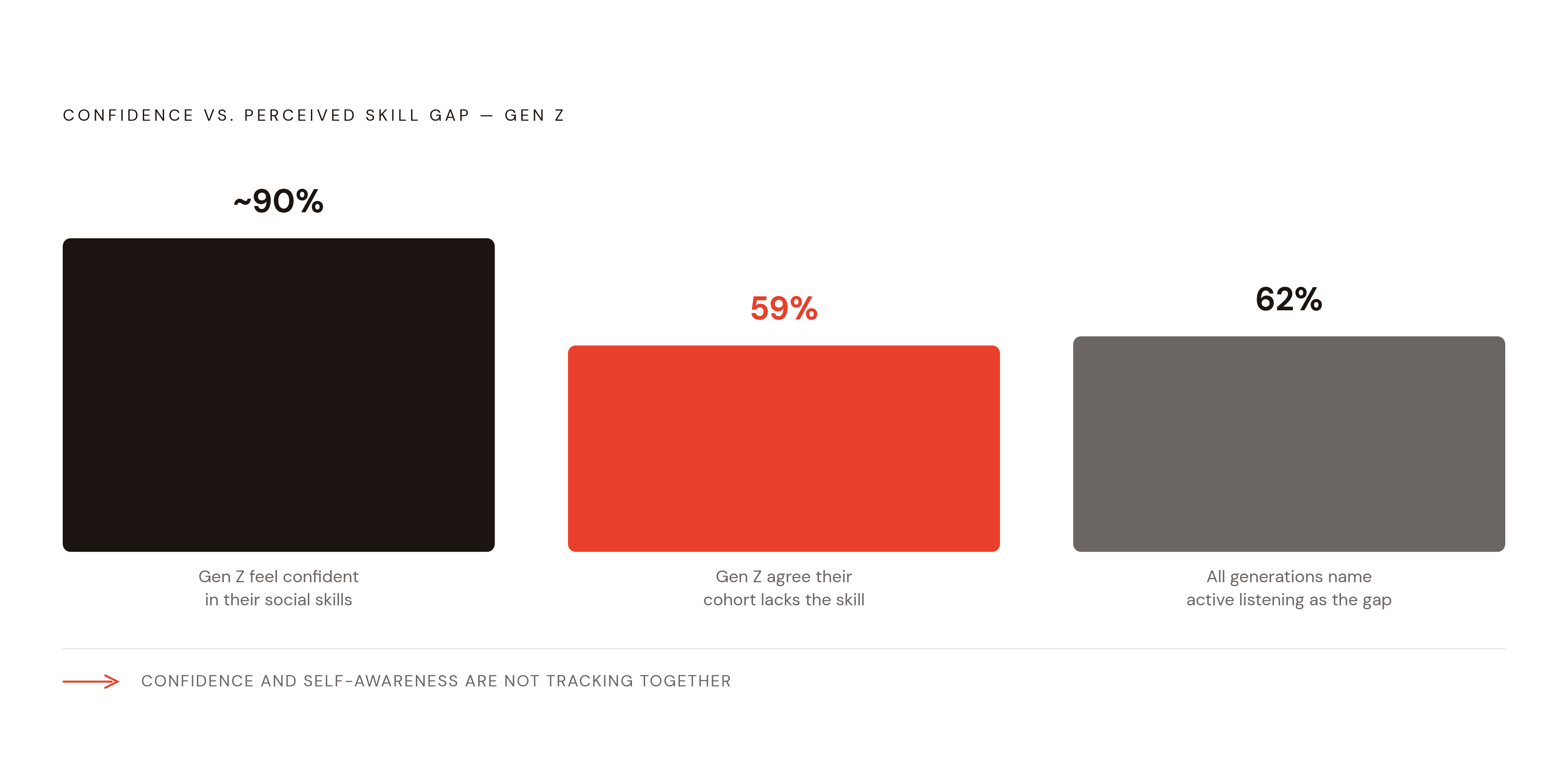
Gen Z, on paper, feels good about all this. A CNBC and SurveyMonkey Social Skills survey, conducted across 1,174 respondents spanning five generations, found roughly 9 in 10 Gen Z respondents confident in their own social skill proficiency, split about evenly between "very confident" and "somewhat confident". That's a strong number. It doesn't hold up against what the rest of the survey found.
Across every generation surveyed, 62% named active listening as the skill young people lack most, and 59% of Gen Z respondents agreed with that assessment about their own cohort. Confidence and perception, in other words, aren't tracking together. Feeling articulate and being heard as articulate are two separate outcomes, and the gap between them is the real story here. Cultural shorthand has already picked up on it: the "Gen Z stare," a phrase that spread widely in online discourse in mid-2025 with roots reaching back to at least July 2024, names the moment older generations read perceived verbal disengagement as social ineptness, whatever the intent behind it actually was.
Employers aren't waiting around for the culture war to resolve itself. Deloitte's survey found that millennials rank public speaking as the single skill they most want to develop, at 39%, ahead of AI fluency and critical thinking. Verbal performance isn't a soft-skills afterthought tacked onto a resume, it's sitting at the top of the list. And Gen Z seems to know it: 91% of Gen Z respondents in the CNBC/SurveyMonkey survey said they want colleges to help close this gap, which reads less like a request for reassurance and more like an appetite for structured practice. That appetite connects straight back to the mechanics laid out earlier. The same planning system that trips over itself under stress, producing a spoonerism or a stalled sentence, is the system that responds to deliberate, repeated, measurable practice. Fluency was never a personality trait handed out at birth. It's a high-speed engineering system the brain runs dozens of times a minute, and like any engineered system, it can be stress-tested, debugged, and built back up through the work of doing it on purpose.
Sources
- A lack of pies for a pack of lies — what spoonerisms reveal about how the brain produces speech • Kansas Reflector
- Spoonerisms: The structure of errors in the serial order of speech - ScienceDirect
- Accidental mix-ups of sounds reveal how the brain produces speech | Scientific American
- A lack of pies for a pack of lies – what spoonerisms reveal about how the brain produces speech
- A lack of pies for a pack of lies—what spoonerisms reveal about how the brain produces speech | CU Boulder Today | University of Colorado Boulder
- The Suppression of Taboo Word Spoonerisms Is Associated With Altered Medial Frontal Negativity: An ERP Study
- Spoonerism
- SPOONERISMS: THE STRUCTURE OF ERRORS IN ...